From .NET Framework 1.0 to .NET 10: 23 years of evolution
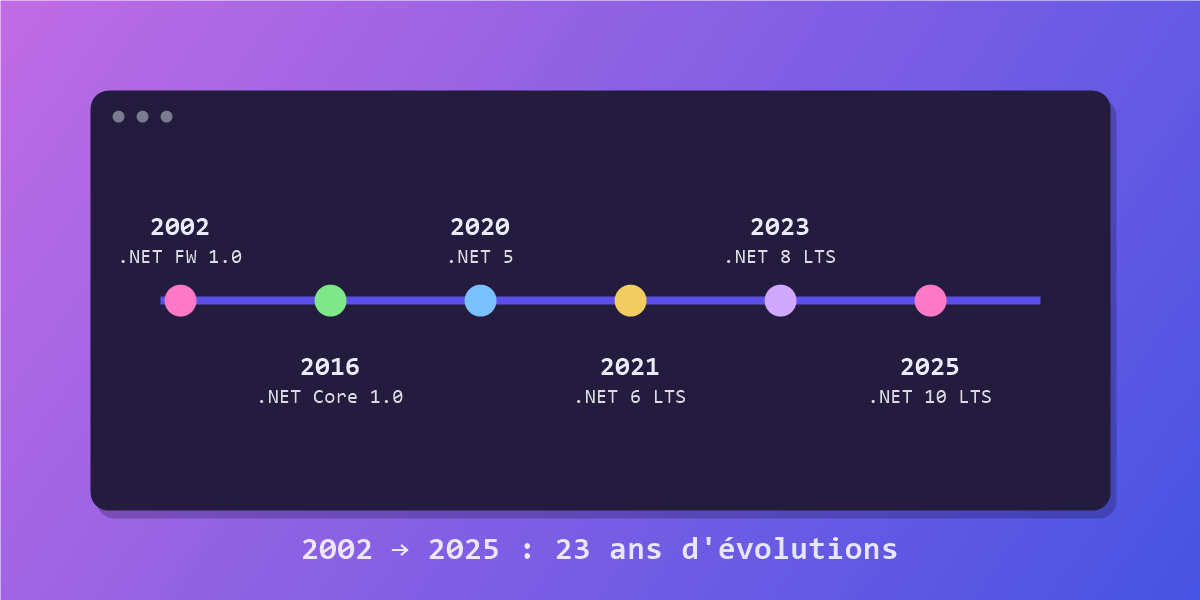
.NET has evolved enormously in 23 years: from Framework 1.0 to .NET 10, the platform has become open source, cross-platform and extremely fast.
And yet many companies still run on .NET Framework, not by choice, but because migrating takes time and resources, especially on large projects. Yet migrating is also an opportunity to cut technical debt and benefit from recent advances.
The milestones that made .NET
2002, .NET Framework 1.0: the birth of .NET, with ASP.NET Web Forms, ADO.NET and Windows Forms. The goal: making Windows application development easier.
2008, .NET Framework 3.5 SP1: first version of Entity Framework, .NET's native ORM.
2010, .NET Framework 4.0: introduction of the Task Parallel Library (TPL) and EF4 improvements.
2016, .NET Core 1.0: a real turning point! The platform goes open source and cross-platform: Linux, macOS and Windows.
2019, .NET Core 3.0: Windows Forms and WPF come back on Core, and Blazor launches, the web framework that brings C# to the client side.
2020, .NET 5: replaces .NET Core and starts the unified platform for desktop, mobile, cloud and IoT.
2021, .NET 6: Minimal APIs arrive to simplify microservice creation, an LTS with better performance.
2023, .NET 8: improved Minimal APIs, a big performance push, new features for Blazor and WebAssembly.
2024, .NET 9: advanced memory optimizations and better ARM support, paving the way for the next LTS.
2025, .NET 10: the current LTS. An even faster JIT, C# 14, ASP.NET Core 10, EF Core 10. I covered what's new in .NET 10 in a dedicated article.
Why so many companies stay on .NET Framework
I completely understand why: with critical apps used by thousands of users, migrating is a big undertaking between regression risks, development time and tests to redo.
Many adopt a progressive approach: they start new projects on recent versions while maintaining the older apps.
Takeaway: .NET 8 support ends in November 2026 and .NET Framework only receives security fixes. Every year of waiting raises the cost of migration. Better to plan it than to endure it.
This article comes from one of my LinkedIn posts (in French): join the discussion ↗